An internal tool is the software your team runs the business on when no product fits the job, such as renewals tracking or an admin panel that lets support look up an account without paging an engineer. It's built on your own Postgres database, and your company owns the code and the accounts it runs on.
I build it myself. The written rules come first and AI agents build against them, so your engineers inherit the rules along with the code.
What changes for your team
Renewals live on the account
Each renewal date sits next to the contract in force and its owner, so the renewal stops living in someone's calendar.
Support stops paging engineers
An admin panel lets support look up an account and handle the routine fixes, which leaves engineers the tickets that need code.
Built with the people who use it
The first version goes in front of the team that will run it, and it changes after they try it.
How it gets built
Fix the mess first. Then build. Then automate. An internal tool comes after the Ops Audit's fix plan, starts with the core, and grows once the people using it have tried the first version.
Renewals and contract tracking
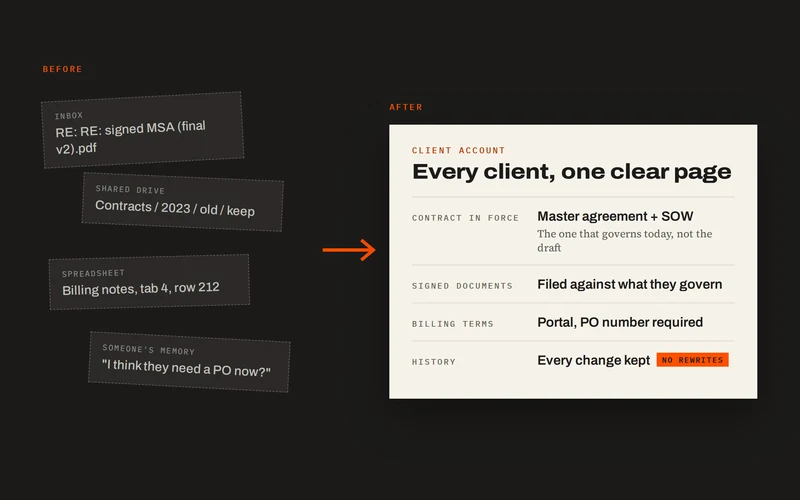
Every account on one page, with the contract in force, the signed documents behind it, and the date it renews.
Admin panels for support
Account lookups and the routine fixes your engineers run today from a database console, behind a screen support can use.
The glue between systems
The API or webhook handler between two tools that weren't built to talk to each other, logged and kept in your own repository.
A support center customers search
A help center and an internal knowledge base, where whoever solves a ticket writes the answer down, so the next customer with that question finds it on their own.
After launch
Who owns the gaps? Since rollout, an early-stage cybersecurity firm selling to enterprises has tracked renewals for 34 enterprise accounts with a small team, in a system the firm owns. Each account shows the contract in force and the signed documents behind it, with a history of every change that can't be quietly rewritten.
The client account and contract system on the portfolio shows how it works.
A support center is built the same way. At Boston Dynamics, the rebuild of support.bostondynamics.com covered the content audit, the design system, and the Salesforce, Jira, and Paligo integration, under ITAR and US and EU compliance. The case study follows it from the audit to launch.
Common questions
When does an internal tool make sense?
When the software you pay for covers most of the job and your team keeps a spreadsheet for the rest. If buying software beats building it, that's the recommendation you'll get.
Who owns the code?
Your company does. The code, the database, and the accounts they run on are yours from day one.
What is it built with?
React, Node, and Postgres, hosted on accounts you control. The written rules ship in the repository with the code, so another developer can pick it up later.